Saturday, April 2, 2016

Batman v. Superman: Dawn of Justice : Fun, but long, but fun, but okay.

Batman v. Superman: Dawn of Justice

Director: Zack Snyder
Stars: Ben Affleck, Henry Cavill, Amy Adams, Jesse Eisenberg

This semester, I’m teaching Introduction to Film, and as soon as I walked into the movie theater to watch Batman v. Superman: Dawn of Justice, I saw one of my students. I stood behind him in line to get my popcorn, and he turned around to tell me, “I’m not here to analyze this movie. Don’t even ask me to analyze this movie.” I laughed and replied, “Hell, I’m just here to watch Batman.” Really, that’s the only reason why I was interested in this movie; I’m more of a Marvel fan than DC, except when it comes to Batman. In any case, there was a new superhero movie, and I was on top of it like flies on a gut-wagon. What I will say about Batman v. Superman is that it was okay—not exceptional, not something that I’m going to rush out to buy when it comes out on blu-ray—but it was okay.

Batman v. Superman: Dawn of Justice begins with a flashback to Superman’s fight with General Zod from 2013’s Man of Steel. Bruce Wayne (Affleck) watches from street level at the alien carnage befalling Metropolis, and he begins viewing Superman (Cavill) as a threat. Superman’s character is tarnished further when Lois Lane (Adams) is taken hostage as she chases a hot lead in the desert, and Superman rushes to save her—though the whole event is orchestrated by Lex Luthor (Eisenberg). Wayne’s distrust of Superman grows, and he explains that if there’s a one percent chance that Superman is dangerous, we must take it as an absolute certainty that Superman is dangerous. Luthor also pulls strings to antagonize Wayne into donning the Dark Knight suit to take on the Man of Steel, and there we get to the whole crux of the movie: Batman vs. Superman in a knock-down, drag-out fight.

Now, I say this movie is okay—not spectacular or exceptional—because I really don’t care for Superman that much. I remember watching Man of Steel and thinking that I didn’t care about the character at all—sure, that movie played up the whole idea that Superman is the only one of his kind and he’s all alone in the universe, but I just can’t relate to him on any level. On top of that, I really don’t care what happens to Superman because nothing can hurt him (save the one obvious thing that crops up in Batman v. Superman: kryptonite). He seems grossly overpowered, and I just don’t care. If I can’t care about what happens to the main character, I’m not going to connect with the movie as strongly.

Because Superman is invincible and grossly overpowered, his fight scenes get a little boring. We see a lot of the same visuals in Man of Steel: laser eyes, explosions, picking up a guy and throwing him into the side of a building and the glass all shatters, etc. Watching Superman fight is like washing your hair—lather, rinse, repeat. He picks up Batman and throws him away; he walks back to Batman on the ground, picks him up, and heaves him through a wall; then he walks back to Batman on the ground, picks him up, and shotputs him through another wall. Since he’s so overpowered, it gets a bit tedious to see him basically do the same move over and over (knowing that he can’t really be hurt). I feel like Marvel superheroes show more character in their fighting styles, and because these are all action movies, that would make sense—you can’t have the superhero do the same fight across two or three movies that need to have their own separate identities. In Batman v. Superman, Superman seems like a one trick pony.

The one refreshing bit about the fighting in this film was Batman, since he actually seems to have a style more his own compared to Superman’s lather, rinse, repeat. In Christopher Nolan’s Batman trilogy, Bruce Wayne learns a number of different combat styles focusing on martial arts, but I found Batman v. Superman refreshing because Batman actually incorporates gadgets into his combat styles instead of relying solely on his mastery of martial arts. Seeing Batman shoot his grappling gun at an enemy, swing him around the room, and eventually throw the guy through a wall was much more gratifying than seeing only martial arts combat. This gadget-based combat style seems more in line with the Batman video games, such as Arkham Asylum, Arkham City, and Arkham Origins. (I still have yet to play Arkham Knight, but I’d need to buy an Xbox One first.) In these games, the player gets bonus points for using gadgets during combat, and this lends credence to Batman’s intellect: he uses gadgets during fights in order to outsmart his enemies and gain an advantage, and that’s something that Batman v. Superman did better than Nolan (though Nolan’s visuals still trump this new iteration).


Now, because we’re on the topic of Batman, we have to talk about Ben Affleck. I keep seeing these screenshots from interviews with Affleck where he just looks like someone’s told him that Batman v. Superman was the worst movie in the world—well, I’m guessing someone’s already said that on the internet somewhere. Really, I didn’t mind him as Batman, but as Bruce Wayne, I didn’t find him all that convincing. Bruce Wayne is supposed to be this dapper, intellectual billionaire genius, right? Affleck didn’t really pull that off for me; for example, in one scene, Wayne attends a party at Lex Luthor’s manor, and while he’s there, he hooks up a gadget that downloads a bunch of encrypted files from Luthor’s mainframe—but he’s caught in the act. Instead of playing things suavely, he says something like, “Oh, yeah, uh…I was looking for the bathroom. All those martinis, huh?” Buddy, you’re clearly standing in what looks to be a server room fiddling with the electronics—this is obviously not something to piss on. Part of it could be the writers’ fault in this particular instance, but part of it was Affleck’s performance of Bruce Wayne. Like I said, as Knight of Gotham, we’re good to go, but as cool, billionaire playboy? Not so much.


Getting to acting, let’s talk Luthor and Jesse Eisenberg. Like I’ve said a hundred times before, I’m a filthy casual when it comes to comic books, but I like the movies, and that’s why I write this blog. That being said (again), can someone tell me if Lex Luthor is supposed to be so obnoxious? Eisenberg’s performance here felt really forced, and I didn’t get the same DC villain vibe as I got with Heath Ledger’s Joker (but really, that’s my gold standard for Batman villains). Again, I’d really like someone to tell me in the comments if Luthor is supposed to be as nutty and annoying as Eisenberg makes him out to be. I remember snips from Kevin Spacey playing this role, and he seemed more like an evil genius than…whatever Eisenberg is doing here. His scenes were honestly hard for me to watch.

The big thing that people have asked me about with this movie is Wonder Woman, especially my partner. I don’t really know much about Wonder Woman, though, and, once more, in case you’ve forgotten, filthy casual. My partner made sure to mention that she only saw Batman v. Superman to support the franchise so that the studio would continue on its track to make a standalone Wonder Woman movie. Do you think, based on the low ratings that Batman v. Superman is receiving, that we’re still going to see a Wonder Woman movie in the near future?


Overall, again, it’s an okay movie with its ups and downs, but two and a half hours seems like a long runtime for this movie when things could have been cut down quite a bit. (I shouldn’t speak too poorly of Batman v. Superman on this point, since Captain America: Civil War supposedly has an equally-lengthy runtime.) Am I going to rush out and buy this movie when it comes out on Blu-ray? No, probably not. I might wait a while for the price to go down and pick it up after a couple of years. 

The real question is this: “Was the movie entertaining?” Hands down, yes. This was a nice afternoon at the movies for me.  

Monday, February 15, 2016

Deadpool: A Fun, Adult Not-Superhero Movie (For Adults)

Deadpool

Director: Tim Miller
Stars: Ryan Reynolds, Morena Baccarin, T.J. Miller, Ed Skrein

Love—and some various body parts—are in the air this Valentine’s Day with the release of Deadpool. Now, dear reader, I know I’ve mentioned this before, but I am a filthy casual when it comes to comic books. Growing up, I never had an outlet for comic books, and I never had any Big Brother-figure to give me hand-me-down comics, either. Going into Deadpool, I didn’t know much about the character—except for what I learned about him from 2009’s X-Men Origins: Wolverine (but let’s not talk about that…ever.) I knew that Deadpool is supposed to be more of an antihero than most other comic book characters, and I knew that Deadpool is a jokester. With fourth-wall-breaking fun, I found Deadpool to be quite entertaining—but Marvel’s villain here, again, was pretty lackluster.

Deadpool obviously follows the exploits of Deadpool, formerly known as Wade Wilson (Reynolds). After being dishonorably discharged from a special ops team, this military man turns mercenary, and he takes contracts to help the little people—as Wilson explains, a punch in the face is earned. As he settles up a contract with his friend, Weasel (Miller), he meets a woman with a sense of humor as dark and deranged as his own; to boot, Vanessa (Baccarin) also shares Wilson’s high-flying libido. Years into their relationship, Wilson learns that he has late-stage cancer throughout most of his body, and he believes he’s sparing Vanessa from watching him wither away by abandoning her. He enrolls in a shady research program under the control of Ajax (Skrein), and with Skrein’s help (read: torture), Wilson’s cancer is cured, and he becomes the avocado-skinned not-superhero we all know and love. Deadpool’s mission? Find Ajax, make him fix the avocado skin, and then kill him.

Now, I mentioned “libido” and “kill” in the last paragraph, so parents, listen up: this is not a superhero movie to take your kid to. Toward the beginning of the film, there’s an extended montage of Wilson and Vanessa as they, uh, push the boundaries of their relationship; at another point, Wilson and Weasel go looking for leads in a strip club, and there’s gratuitous nudity— It’s a strip club! (Here, I looked over at a father and son in the theater, and the father leaned in close to his kid, likely saying, Don’t you dare tell your mother about this.) Along with the sexual encounters we see on screen, we also hear about as much sexual humor as you’re likely to get from Deadpool. On top of that, there’s still a high level of ultra-violence that’s supposedly a trademark of Deadpool, from splattering blood to downright decapitation to full-on flattening. There’s an R-rating for a reason, people, and you’ve been warned. Find a babysitter, ditch the kids, and see this movie for yourselves.


Really, I can’t think of another actor who could play Deadpool like Ryan Reynolds. It’s a little disgusting to think about, but his prior performance as Wade Wilson in X-Men Origins: Wolverine stole the show, and I’d have loved to have seen a stand-alone Deadpool movie back then. This style of comedy—one full of punchy dialogue and physical humor—is right in Reynolds’ wheelhouse. Deadpool’s comedy seems to harken back to his performance in Waiting, a comedy about raunchy restaurant staff from 2005 full of similarly-punchy dialogue, and Reynolds shines in that type of humor. His comedic timing is what sells his comedic performances, and his calling card is a tell-tale pause that helps drive his character’s jokes. His comedic acting here isn’t just about his dialogue, though—his job becomes even harder because he has to bring that same silliness without using his face, since he wears the Deadpool mask throughout a good portion of the movie. Overall, Ryan Reynolds is Deadpool, and Deadpool is Ryan Reynolds; he was literally born for this role after “…Freddy Kreuger face-f*cked a topographical map of Utah.” A friend mentioned that Ryan Reynolds has been wanting this movie to be made for years, and he actually took a good deal of the production onto himself, proving, again, that he is the actor for this particular character. 

The beauty of the Deadpool character is his versatility, since Deadpool can be everyone and everything. I know I’ve leaned on this book before, but I’m again reminded of Cormac McCarthy’s border fiction: Blood Meridian’s seeming main character, simply known as “the Judge,” is larger than life—a suzerain of the earth, he calls himself. Literary critics try to interpret his character time and time again, and all of the interpretations fit, so you can’t really say they’re wrong, since he fits and simultaneously doesn’t fit these various categories. The same can be said about Deadpool—all of these interpretations fit. No matter how absurd the situation, Deadpool always finds ground to stand on, and because of this, the character pushes a lot of boundaries and almost denies classification.

Because of this versatility in Deadpool’s character, one of the greatest things I thought about this movie was the sex positivity—much of which is shown on-screen (again, leave the kids home). Since the beginnings of film, Hollywood and the film industry have largely promoted heteronormativity—a love story can only involve a man and a woman. We see the same thing in Deadpool in Wade’s early relationship with Vanessa, sure, but with that heteronormativity, there’s a good level of sex positivity—once more, going back to the sex montage, it’s clear that they have a healthy relationship based on exploring one another’s sexuality. Once we see Wilson’s transformation into Deadpool, however, we see even more exploration in the character’s sexuality: the internet has been throwing around words like “pansexual” and “omnisexual,” meaning that Deadpool sees anyone as a sexual partner. Dan Tracer explains, “Deadpool has been portrayed as an omnisexual flirt who will go after any gender that happens to strike his fancy at any particular time,” and those moments of “any particular time” flash on the screen over and over and over. Again, the versatility afforded in the Deadpool character means that he can be anything, and it was refreshing to see less heteronormativity on-screen (plus, Deadpool more or less gropes Colossus’ metallic manhood, which got big laughs in my showing).

The issue I have with this movie is the same one that I had with Ant-Man last summer: the villain isn’t threatening or memorable. Ajax, a mutant with heightened reflexes and nerve endings that don’t work (meaning he feels no pain) seems like he could be an interesting villain, but part of the problem here is that he feels more like a henchman than a supervillain—think of Bane in Christopher Nolan’s The Dark Knight Rises. “As Ajax, Ed Skrein fails to become a truly threatening or memorable villain,” Daniel Krupa notes, “since he’s given so little to do.” The whole point of Ajax in the movie is to fulfill Deadpool’s revenge plot, and he doesn’t have any real endgame—there’s no villainous terror plot that has to be stopped like in Avengers: Age of Ultron that would connect him to the larger world or make it feel like there’s more at stake than simple revenge. Really, the worst thing he does is create mutants through medical experimentation and torture, and then he sells the mutants as slaves to the highest bidder, whether that bidder is a government entity or a real supervillain. Now, is this a villainous thing to do? Obviously, yes, but because there’s no real checkmate coming that Deadpool has to prevent, there wasn’t much tension in the character, so I have to chalk this up to another Marvel movie where the main character has to destroy a foil of him- or herself.


Overall, would I watch Deadpool again? Hands down, yes, and I plan to buy it when it comes out. While the film didn’t stray too far outside the boundary of the superhero genre, it does stray a bit further in making fun of that genre—the beginning of the movie attests to that, since the opening credits list the director as “an overpaid tool,” and they mention a “British bad guy” and “a super hot girl” instead of listing any actors’ real names. The actual plot may not push many boundaries, but the metacommentary on the genre through the numerous times that Deadpool breaks the fourth wall and speaks directly to the audience is really refreshing, and it almost made me engage with the movie more, since it felt like we were all in it together. If you have the time to spare and want to have a lot of laughs at an odd take on the superhero genre, this is the movie to see.

Outside readings:

Krupa, Daniel. “Deadpool Review.” IGN. IGN, 6 February 2016. Web. 15 February 2016.
            <http://www.ign.com/articles/2016/02/07/deadpool-review-2>.

Tracer, Dan. “First Queer Superhero Lead? Ryan Reynolds Opens Up About ‘Deadpool’s’ Fluid
           Sexuality.” Queerty. Queerty, 4 November 2015. Web. 14 February 2016.
           <http://www.queerty.com/first-queer-superhero-lead-ryan-reynolds-opens-up-about-
           deadpools-fluid-sexuality-20151104>.


Sunday, January 17, 2016

The Revenant: An Artistic Twist on America's Fur Trading Days

The Revenant

Director: Alejandro G. Iñárritu
Stars: Leonardo DiCaprio, Tom Hardy, Domhnall Gleeson

Again, I emerge from the void, awakened from the hibernation of a cold winter’s day, to write a reaction to Alejandro G. Iñárritu’s The Revenant. Out of the all the movies I’ve reviewed in this blog, I think this one hits the closest to my homeland—the upper Midwest.

The Revenant focuses on the (mis)adventures of Hugh Glass (DiCaprio), a frontiersman and tracker who is stationed with a fur trading company led by Captain Andrew Henry (Gleeson). After a gruesome, exciting, and artistically-beautiful opening sequence where the fur trading camp is attacked by Native Americans, Captain Henry and his men flee into the wilderness and attempt to reach their fort. The ever-complaining John Fitzgerald (Hardy) worries only about his fair payment after the company’s men are run off and killed. After Glass is gruesomely wounded, Fitzgerald volunteers (for extra pay, of course) to nurse Glass back to health or give him a proper burial while Henry and the other men return to the fort; Fitzgerald, being the stand-up buddy he is, kills Glass’s son, Hawk, and leaves Glass for dead in a half-dug grave. Glass struggles to survive in what one woman in my viewing called “the longest, most boringest movie [she] ever seen.” Did I mention this movie is gruesome?

With a nearly three-hour runtime, yes, it’s a long movie, but if you actually pay attention to what’s on-screen, it really is a beautiful and engaging film. As I mentioned, the opening sequence showing the attack on the fur trading camp is masterfully done; to boot, there is very little actual cutting taking place. The choreography that went into some of these long-duration shots must have been obscene as the camera focuses on one man, follows him to his death, then follows the first man’s attacker to his death, and on, and on, and on. Furthermore, the special effects in this film make it totally engaging, enough so that the audience gasped and cringed at some points.  If the woman I mentioned above was looking for a spaghetti Western where the lawman shoots the bad guy at high noon and rides off into the sunset, she was in the wrong theater: this was art.

Speaking of art, there was some phenomenal acting here from Tom Hardy. Hardy took on an excellent character, and he was believable through and through. His portrayal of Max Rockatansky in Mad Max: Fury Road was great, and he made for a very menacing Bane in The Dark Knight Rises; that being said, I love that Hardy can immerse himself in his characters well. That’s what I consider great acting: when an actor takes roles with such stark contrasts, but I can’t see any prior performances in this new performance (if that makes sense). Hardy is nominated for an Oscar as Best Actor in a Supporting Role, and I’d say he’s a major contender in that arena.


Above: Tom Hardy as John Fitzgerald
I can’t say the same about Leonardo DiCaprio, however. In interviews I’ve read and watched, DiCaprio has said that this is the hardest role he has ever played, and that could partially stem from the fact that Hugh Glass suffers an injury to his throat (spoilers are unbearable), and the character doesn’t speak for a good chunk of the film save grunts and gasps. DiCaprio has been nominated for an Oscar as Best Actor in a Leading Role, but part of me wonders if he’ll win this year (finally) or forever be a bridesmaid and never a bride. Going back to what I said about great acting and actors who take on distinctive and contrasting roles, DiCaprio has done that—time and time again—but I always see his facial expressions or hear subtle nuances in his delivery and think, Oh, that sounds like when he played that other character in that other movie. He was engaging the whole time, and his acting was believable, but I guess I’m on the fence about this performance being Oscar-worthy.

One of the most poignant themes I kept coming back to while watching this movie, though, was that nature is not your friend—leave your Tolkien at the door, kids. 95% of the movie takes place outdoors and shows Glass being flung off of cliffs, drifting through whitewater rapids, or damn near freezing to death, and overall, it very much reminded me of reading books from Cormac McCarthy. In McCarthy’s novels, it’s not just Native Americans or Mexicans or the Judge who is out to get you—it’s the world, itself. The environment in McCarthy’s novels seems to take on a life of its own as though it, too, is a character that works against the Glanton Gang in Blood Meridian, for example, and that seems to be the case throughout The Revenant.

This similarity to McCarthy’s work is echoed in the gender issues presented in the film, in that there really aren’t any women. Again, if you’re looking for a stereotypical Western with a spunky female lead who falls for the lawman cowboy, this isn’t the movie for you. One review wrote of McCarthy’s novels that he presents a world where “woman” is not yet realized; in this movie, the only women who appear are a kidnapped Native American woman and Glass’s deceased Pawnee wife. While the kidnapped woman does get a single line, Glass’s wife appears to him throughout the movie as figment of his dreams, and we frequently here a voiceover refrain from her. Past that, there are no women to be seen throughout the whole movie. At some points, it subtly hints at constructions of masculinity, and there are a few other places where Fitzgerald all-too-bluntly emasculates his fellow fur traders. 


I was excited going into this movie, as it's a far cry from the movies I generally gravitate toward, and that initial excitement wasn't wasted. If you're looking for an artistic representation of the fur trading days of America, this movie should be right up your alley. 

Wednesday, July 29, 2015

Tusk: Kevin Smith's Misguided Stab at Horror-Comedy

Tusk

Director: Kevin Smith
Writer: Kevin Smith
Stars: Justin Long, Michael Parks, Haley Joel Osment, Genesis Rodriguez

In this first installment of the “Yesteryear” posts, we’ll be tackling Tusk, the newest film from Kevin Smith that came out last year. When I heard about this movie, I was really excited—I normally love Kevin Smith’s films, and the whole premise sounded pretty funny. You’ll notice that I said I normally love these flicks. That’s because Tusk left me utterly confused as to what genre Smith was shooting for here.

 Tusk tells the story of a foul-mouthed podcaster named Wallace Bryton (Long). He and his friend, Teddy (Osment), run a podcast show called the “Not-See Party,” where Wallace watches a weird news video and explains what’s happening to Teddy, who doesn’t even see the video (hence the “Not-See” part of the podcast’s title). Wallace travels to a small town in Canada to interview a viral video sensation, but when his potential podcast story falls through, he needs to find another piece of weird news. In the bathroom of a Canadian bar, he finds a cryptic, handwritten letter pinned to a bulletin board; following the instructions on the letter, he arrives at the mansion home of an eccentric, wheelchair-bound man named Howard Howe (Parks). Howe’s stories seem too good to be true, which Wallace soon finds out. When the mysterious Howe takes Wallace as a prisoner, Wallace’s girlfriend, Ally (Rodriguez), and Teddy desperately search for him.

The genre of this movie was the most confusing thing for me. Smith’s heyday was in the 1990s, and most of his movies—if not all—were comedies. One of my favorites was Dogma, a hilarious poke at religion featuring Matt Damon and Ben Affleck, but he’s probably most known for his black and white Clerks. Smith’s comedies are absolute gold with endlessly-quotable dialogue and quirky, memorable characters. I didn’t get the same vibe with this movie, though, because Smith tried to make a horror-comedy…emphasis on the tried part. There’s a fine line between horror and comedy, and it takes a delicate balance between both genres to make it work. I recently watched a movie called Zombeavers—radioactive zombie-beavers attack a group of college students. Also, see Tucker and Dale vs. Evil, where two hillbillies go to the lake and accidentally run into some college students who are convinced the two yokels are Deliverance-style murderers. I thought both of these movies were great, simply because they didn’t take themselves too seriously—they knew that they were couching a horror movie in terms of a comedy, or vice versa, and they were okay with it.

I feel like Tusk went too deeply into each of these genres instead of blending the two together. There were plenty of parts that I thought were purely horror instead of trying to make a horror scene funny. Part of the issue there lies with Parks’ performance. In many of his scenes, he actually comes off as a genuine psychopath, which was actually pretty scary, and Howe’s dialogue toward Wallace is frightening. The cinematography of Parks’ character during some of these scenes reinforces that menacing portrayal. For a horror-comedy, things got a little too real during the scenes showing Wallace's abduction and captivity at the hands of Howe.

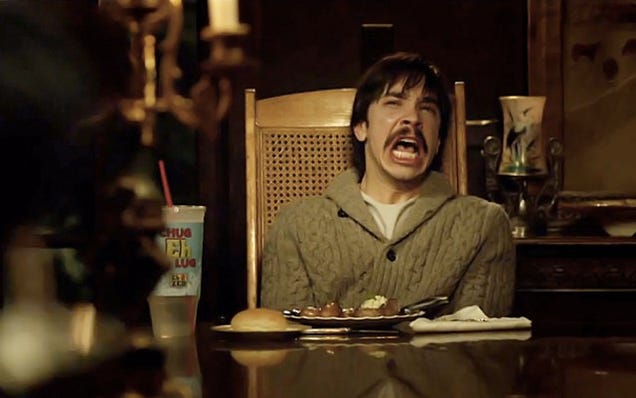
Another seemingly miscast role was Justin Long. There are certain roles where I think Long is a decent comedy actor—he was great in Dodgeball as a geeky teenager, and his similar role in Accepted as a smart-mouthed college kid was enjoyable. Smith has used Long in a cameo role previously in Zack and Miri Make a Porno, portraying a gay porn star, and I found that incredibly funny. A lot of these roles were pretty over the top in the comedy stuff, and comedy is right in his wheelhouse. Tusk, however, represents a role way out in left field. The seriousness of some of the horror scenes don’t fit Long’s acting style at all—as he tries to spin a comedic character, he’s painfully unfunny. For having just met Howe, a mysterious old man who Wallace plans to interview, Wallace speaks with a disgustingly-unamusing candor, almost like Long (or Smith as the writer) was trying too hard to inject some laughs into the mix.

The pendulous way Smith swings from horror back into comedy feels really jarring, and again, it’s hard to tell if he was trying to make a horror film, a comedic romp, or a horror-comedy. Instead of blending the two genres together, we get a comedic sequence followed by a horror scene, then back and forth and back and forth. After one scene that’s actually pretty disturbing where Howe drugs Wallace and experiments on him, the audience is snapped back to Teddy and Ally’s search for Wallace—a search that’s supposed to be hysterical, but ends up being the same trying-too-hard string of jokes. The whole movie hinges on Canada jokes and Canadian stereotypes, and as I watched, I felt secondhand embarrassment for any Canadian viewers. These drawn out sequences absolutely rag on our lovely neighbors to the north, and it was, again, painfully unfunny.

This is, in all honesty, the first Kevin Smith movie that I’m not happy that I watched. There was a laugh or two that I got, but most of the humor in this movie just grated on me and didn’t even make me smile. This movie was based on a “smodcast” from Smith, and a friend of mine said she really enjoyed Tusk since she’d been listening to the movie take shape through these smodcasts. Part of me wonders if it wouldn’t have been better if Tusk had just remained an idea that floated around the smodcast studio and nothing more.


Now that that painful review is over, you may have noticed a small addition to the top-right corner of this blog. I've registered Ticket Stubs and Popcorn Tubs with Bloglovin', which makes it easier for you to follow your favorite blogs and search for new blogs that pique your interests. Give it a shot!

Wednesday, July 22, 2015

Ant-Man: Another Marvel Movie with a Boring Baddie.

Ant-Man

Director: Peyton Reed
Stars: Paul Rudd, Michael Douglas, Corey Stoll, Evangeline Lilly

I’ll throw this out there: I’m a Marvel drone. If it says that Marvel produced the movie, if there’s a cameo from Stan Lee anywhere in the film that makes me laugh, and if there’s an extra scene during the credits, I’m all in. I won’t lie to you, though, my dear reader—I didn’t read the comic books. I never read the comic books. I never had access to them growing up, and it’s only since this latest explosion of superhero movies that Marvel has really piqued my interest. That being said, I felt like 
Ant-Man was a little different than the other Marvel movies. I certainly don’t mean to say that this is an entirely bad addition to Marvel’s ever-expanding cinematic universe—it just felt different.

Ant-Man is a superhero origin story that begins with the release of a prisoner, Scott Lang (Rudd). Lang struggles to find work on the outside, since he's considered a felon—a cat burglar, to be more exact. When the struggle to find a job becomes too much, Lang falls back into old habits and expertly burgles the house of Dr. Hank Pym (Douglas), a scientist who allegedly worked on shrinking technology that reduces the space between atoms. Upon breaking into Pym’s vault, he discovers a red suit, and, being the curious type—fitting for a cat burglar, I suppose—Lang puts on the suit and becomes the Ant-Man. Pym’s former assistant, Darren Cross (Stoll), and Pym’s Daughter, Hope (Lilly), are working on that same shrinking technology, however. Cross develops a suit—named the Yellowjacket—that has the same atom-shrinking abilities, though he sees his weaponized suit as one that will end all wars and make him rich in the process. Lang, Hank, and Hope team up to take down the Yellowjacket to stop the shrinking technology from falling into the hands of the military.

With Ant-Man coming out after the massive release of Avengers: Age of Ultron, it seems like this movie isn’t getting nearly as much hype despite a good amount of advertising. A big part of that is most likely that people like me—people who haven’t read the Marvel comic books—aren’t really sure who Ant-Man is. Iron Man is a huge Marvel character who’s had several movies already, and the same goes for Thor, Hulk, and Captain America. Even before their movies came out, though, I could tell you who each of those characters was, but Ant-Man? I’d never even heard of him before. I think that’s how a solid chunk of movie-goers are going to react to this movie.

Being released after Age of Ultron isn’t going to do Ant-Man any favors, either. With the massive blockbuster success of the second installment of The Avengers, it’s almost like getting sloppy seconds with Ant-Man. Age of Ultron was talked about extensively, and there was a decent-sized advertising campaign, which probably led to its $191 million opening weekend. According to the Internet Movie Database, Ant-Man pulled in just $57 million in its opening weekend. Again, I’m sure there were plenty of avid Marvel fans who have all the comic books lining up at the doors for Ant-Man, but for the average fair-weather Marvel fan like me, I wasn’t really sure what I was getting into.

Like I said when I started, Ant-Man isn’t entirely a bad movie—it’s just different. With Peyton Reed in the director’s seat, I remember a little bit of backlash from the fanbase. Age of Ultron’s director, Joss Whedon, is known for quick-witted dialogue between his characters (just look at his cult television series Firefly) That sharp-tongued humor seems like a good fit for the Marvel cinematic universe if we take anything from the Iron Man movies as well as Guardians of the Galaxy. With Ant-Man, it seems like they were stretching that humor pretty thin. There were funny parts throughout the movie, but none of them seemed as raucously funny as Age of Ultron was. The biggest stretch for humor was the inclusion of Lang’s bumbling crime-buddies who help him set up the heist of Pym’s house. They were a little too slapstick for my taste, and I was a little disappointed that that same level of quick-witted humor wasn’t in this movie. I think the biggest laugh I got was from Stan Lee’s cameo.

My one big complaint was 
Ant-Man’s villain, Darren Cross/Yellowjacket. I get it: 99% of superhero movies dwell on the “good vs. evil” idea, and Ant-Man isn’t an outlier. Yellowjacket is just a foil to Ant-Man in this regard, and neither Yellowjacket nor Cross really get that much character development throughout the whole movie. Hank explains early on that a biological organism must be protected by a special suit when going through the shrinking process, lest the suit’s fuel start fiddling with the chemistry of the organism’s brain. From Cross’s first scene, we already know that he’s the bad guy, since he’s trying to use this astounding technology (A) as a weapon and (B) to make himself stinking rich. I was really miffed as to why the director didn’t flesh out this brain chemistry thing—Hank brings up this idea to Cross just before Cross dons the Yellowjacket outfit, but it seemed too little, too late at that point. Even if there was one quick sequence of Cross using the shrinking technology that tried to show the audience how it altered his mental state, it would have felt less like a loose end while also giving this character more (much needed) depth. I thought Graeme McMillan summed up the issues with Marvel’s villains pretty well in this article.


Will I be rushing out to pick up a copy of Ant-Man when it comes out on blu-ray? Probably not, but it might be nice to have a Marvel movie collection one day. Was it still an enjoyable movie? Sure, if you’re in the mood for a generic villain who you won’t remember once the credits roll.

Now for some house-keeping. I’d like to write here more than I do now, but I don’t have the means to go to the movies on a weekly basis at roughly $15 a pop. Therefore, I’m going to write posts about random movies I find and title it “Movies from Yesteryear.” There are plenty of movies on Netflix and Amazon Prime that I simply haven’t gotten to yet, and when they originally came out in theaters, I thought, “Wow, that’d be cool to write about.” Then they went out of theaters, and I completely forgot about them…until now! Hopefully, by writing about all movies and not just new releases, it’ll give me a little more fodder. Have any other ideas? Let me know!

Tuesday, June 23, 2015

Jurassic World: a Wannabe Horror Flick with a Mediocre Monster

Jurassic World

Director: Colin Trevorrow
Stars: Chris Pratt, Bryce Dallas Howard, Ty Sympkins, Nick Robinson

Like I said in my earlier review of Godzilla (2014), I’m not really one for creature features, but the Jurassic Park franchise will always have a special place in my heart. To get into the spirit of this movie review, I turned on the John Williams station on iHeart Radio.

In Jurassic World, we follow Zach (Robinson) and Gray (Sympkins), brothers who visit the rebuilt, reinvented, and revamped dinosaur theme park. Claire (Howard) oversees the park and all its guests—including her nephews, Zach and Gray—and makes sure the park is financially successful. The park’s success depends on new attractions, and Claire calls on Owen (Pratt) to consult on Jurassic World’s newest member: Indominus Rex, a scarier, cooler dinosaur (kind of).
If you know anything about the older movies in this franchise, you know that Jurassic Park was the brainchild of billionaire John Hammond, and, as we remember, Hammond “spared no expense!” The same is true for this new park—hamster balls that carry guests through the dinosaurs’ pen, trackers embedded in all the dinosaurs to track their movements, and even a genetically-engineered killing machine dinosaur! Oh, wait…probably should have left out that last one.

I love this movie franchise, but at some points in this movie, things got a little ridiculous. I was immediately reminded of a stand-up comedy special from Eddie Izzard who explained Napoleon and Hitler’s plans for invading Russia (viewer discretion advised—language):

"I've got a better idea, got a better idea...OH, it's the same idea, it's the same idea."

After Hammond’s original Jurassic Park was decimated by dinosaurs, one would probably think, “You know, we probably shouldn’t do this again. That was pretty bad.” After the events of both Jurassic Park: The Lost World and Jurassic Park III, wouldn’t somebody have thought, “You know, this was a really stupid idea, what with playing God and all. What a terrible idea.” Now, we seemingly have Hammond’s replacement, Simon Masrani, running the show and providing the funding, and he even says, “The key to a happy life is to accept you are never in control.” Apparently, a happy life would be to accept that you’re never in control—and in doing so, you’d not get eaten by a genetically-engineered killing machine dinosaur.

I must say, however, that the killing machine dinosaur was a bit underwhelming. In Jurassic Park (1993), I remember how terrifying the Tyrannosaurus Rex was, and Indominus Rex didn’t give me that feeling. Steven Spielberg built the suspense surrounding the T-rex using a lot of sounds—I’m sure we all remember the thundering steps in the background as the camera zoomed in on the water rippling in the cup, and who could forget that piercing roar? The Indominus Rex honestly wasn’t all that memorable, and I thought it looked like a Tyrannosaurus Rex with some spines on its back and a longer body. Whereas Jurassic Park’s main monster will forever be burned into my childhood memories, the Indominus Rex of Jurassic World was pretty forgettable.

My partner told me about her viewing experience of Jurassic World, and she noted that the Indominus Rex had some weird special abilities that make it the perfectly-engineered killing machine that “sparing no expense” can buy. I totally agree with her there—the abilities of this baddie dinosaur feel almost tacked on. The geneticist who engineered the Indominus was told to make a “cooler” dinosaur to make Jurassic World a relevant theme park again—guys, you have dinosaurs. (How is this NOT relevant? Jurassic World even featured a dinosaur petting zoo and triceratops rides! Guys, come on!) In any case, these abilities aren’t really explained until later in the movie—the Indominus Rex is a hybrid of multiple animals, and it apparently inherited all of the strengths of those animals, such as camouflaging. The Indominus needed to be overpowered so that it was scary, but because it’s explained so late in film, it’s almost like the writers were saying, “Oh yeah, we forgot to explain why the monster can camouflage…Because we spliced it with a cuttlefish? Yeah, that’s good enough.” Had they explained early on that we spliced this monster together with Animals X, Y, and Z, then discovered that it could do these things, that would have fixed things, I think.

Before the movie had even come out, a buddy asked how I reconciled the Indominus Rex being both female and monstrous, saying that I should watch the Jurassic World trailer and then interpret from that. I can’t formulate an interpretation of a character’s gender when a two-hour movie is boiled down into a two-minute trailer, and at the time, this was the only answer I gave.

Now that I’ve seen the movie, the Indominus Rex had a more masculine construction.. It was a big deal in Jurassic Park that all the dinosaurs were female, because “Life, uh, finds a way”—when humans meddle, problems arise, such as the destruction of the whole theme park. I suppose same theme of gender follows to Jurassic World—the geneticist specifically notes that the Indominus was not bred, but engineered. It seems like this film’s context sets up the idea that genetic engineering and science are masculine activities, and in the real world, that still seems to be the gendered stereotype (though it is just a stereotype). Ergo, the manufacturing of the Indominus Rex in the Jurassic World lab sets the character up as masculine. This masculine construction is pushed further when Hoskins, a corporate big-shot and military visionary (or so he thinks himself) suggests that the Indominus Rex could be used as an asset in warfare: the dinosaur can camouflage itself to hide even from the most advanced detection systems, making it the ultimate stealth operative (except for, you know, being a 50’ long dinosaur). Because the military is so often couched in masculine terms, it seems that the gender construction of the Indominus Rex is masculine.


If we’re talking about Jurassic World with a gendered lens, there’s definitely some sexism going on here, and that’s been a prevailing review of this film. Several people have equated Claire with the archetypical stiff-shirt, career-good-family-bad female character, and as soon as Owen steps on the scene—a man who acts as a “life-force,” Joss Whedon said—then she changes her act and falls into a traditional gender role. As soon as I read some of these reviews, I began nodding, because a lot of if seems pretty spot-on. Claire doesn’t evoke the same level of bad-ass as Dr. Ellie Satler in Jurassic Park, and that’s pretty clear throughout the whole movie. She has a moment or two of breaking traditional gender roles, but that’s about it. I was pretty disappointed in that—going back to my post about Godzilla, I don’t really see much for strong female characters or feminism, for that matter.

It was a good movie—don’t get me wrong. It had action, the pacing was pretty good, and the visuals were spectacular. I also appreciated the subtle and not-so-subtle nods toward Spielberg, such as the younger actors as main characters and the use of shadows throughout the film. Jurassic World got me right in the nostalgia as soon as John Williams’ iconic theme music came on in the theater, but it also showed some invention to the franchise. The movie definitely sets up a sequel, and you’ll definitely find me at the movies when it happens.

Tuesday, June 2, 2015

Mad Max: Fury Road, a High-Octane Feminist Ride

After an absurdly-long hiatus (in which I finished off my master’s degree in English and found a job teaching college English), another post! Seriously, it’s been a year and two days since my last post in this film blog, though I’ve watched numerous films. I even taught a film class this past semester! Thus, it seems apt that I restart this project of mine.

Mad Max: Fury Road
Director: George Miller
Stars: Tom Hardy, Charlize Theron, Nicholas Hoult

What I originally thought was a reboot, Mad Max: Fury Road begins with our hero, Max Rockatansky (Hardy), being taken prisoner. He’s taken in chains to the Citadel, a stronghold that’s built into the side of a group of mesas in the post-apocalyptic world. The Citadel is the property of Immortan Joe, a warlord whose face is always covered by a razor-toothed respirator. In a flurry of action, Max escapes the Citadel with Furiosa (Theron) on the “War Rig”—a souped-up, double-engined semi-truck covered with as many pointy thing as there are hairs in my beard. Max discovers that Furiosa is attempting to smuggle Immortan Joe’s slave-wives—what he calls his “breeders”—away from the Citadel to a safe place called the Green Land. High-octane, stylized violence in a desert wasteland? It’s going to be a bumpy ride. (Don’t forget your seatbelts, kids!)

The first thing I want to address is the film’s focus, which doesn’t necessarily lie with its title character. Rather, the story focuses more so on Furiosa’s quest to get Immortan Joe’s slave-wives to freedom. On a recent forum, I read one person who griped that the movie was called “Mad Max,” not “Mad Max and Furiosa.” Another person complained that the story isn’t even about Max, and that he’s simply thrust into Furiosa’s story. This seems like a misunderstanding of Mad Max’s character, however, since Max is essentially nomadic. If we think back to the original Mad Max: The Road Warrior, Mel Gibson’s character was set up to not belong anywhere. Even the name “the Road Warrior” suggests a level of transitoriness—Max is always on the move, and that can be seen in the opening of Fury Road, as Max stands alone next to his car. That’s basically what his character does—he tags along and helps in other people’s stories, and that kind of character can mean a lot of sequels, since writers can treat the character episodically. As soon as Max finishes helping Furiosa, he can be back on the road and looking for another adventure in which to partake.

The biggest item on the agenda of Fury Road is gender—and it seems like some people are getting hung up on it. Take, for example, this interviewer who asks Tom Hardy if this is supposed to be a “man’s movie”:


On the surface, Fury Road may be just that—a “man’s movie”—but the film implies that this post-apocalyptic wasteland is the result of hypermasculinity. Visually, Immortan Joe is a hypermasculine character: between his hair and his body, he seems far larger than nearly all of his followers, and his muscles are highlighted by his clear, plastic armor plastered with various medals and ribbons from military triumphs. The other two warlords we see in the film are also portrayed as hypermasculine: “the Bullet Farmer” wears a coif made of gun-belts, again bring his military conquests to the forefront; “the People Eater” portrays his hypermasculinity through wealth, as he adorns himself with gold chains and drives a Cadillac-bodied semi-truck. Three of the most socially-powerful characters in the film achieved their position via hypermasculine practices, it seems.

Looking specifically at Immortan Joe, his treatment of those he deems as his inferiors—men, women, and children—shows him as hypermasculine. Joe controls the flow of water throughout the Citadel, and the unwashed masses who live in the dirt below the stronghold are only alive because of his gracious dispensing of the water…by dumping it on them. To Joe, these people are his property, and this is exactly how he treats his wives—especially how he keeps his wives locked up in a vault to use at his disposal. In addition to being locked in vault, their sexuality is also under lock and key, as each of the wives wears a metal chastity belt—a belt with spikes where any mate (besides Joe, of course) would get his member stuck in a very gruesome way. Joe’s feels the need to protect these women, but not because they’re people, no. They’re his property, and Joe’s only reason for keeping them is because they can carry on his perfect, patriarchal, patrilineal family.

There are plenty of strong feminist characters in Fury Road, and that made me really happy. (If you look back at my post about 2014’s Godzilla, it really was a breath of fresh air to have so many strong female characters. Where Immortan Joe see his “breeders” as little more than incubators for his potentially-patrilineal offspring, these women explore a newfound freedom as soon as they’re clear of the Citadel (and as soon as those clunky chastity belts are off). If I understood the movie correctly, it was actually one of the brides who first planned the escape with Furiosa. As the women scream at Joe during one of several visually-stimulating car chase scenes, “We are not property.” I found it interesting that the production team brought on a writer from The Vagina Monologues as a consultant, just to make sure that the female characters were portrayed well; I’ve never heard of another movie doing that, and I thought it was a nice touch. On the topic of strong feminist characters, do I even need to talk about Furiosa, the badass War Rig driver with the mechanical arm?

Overall, this was a hell of a movie. It’s full of action, car chases, and fight scenes, and the pacing of the movie feels good—it doesn’t seem like it drags out or rushes through anything. Visually, this is a stunning movie; I read on IMDb that director George Miller wanted the cinematography to be as colorful as possible to set Fury Road apart from other apocalyptic movies where the colors are all washed out (see The Road, and you’ll understand). The acting is all on-point, and it was engaging all the way through. I would highly recommend this one. Seeing a Valiant Charger mounted on tank treads is all fine and good, but having a movie with this much depth makes for a great experience.