Wednesday, July 29, 2015

Tusk: Kevin Smith's Misguided Stab at Horror-Comedy

Tusk

Director: Kevin Smith
Writer: Kevin Smith
Stars: Justin Long, Michael Parks, Haley Joel Osment, Genesis Rodriguez

In this first installment of the “Yesteryear” posts, we’ll be tackling Tusk, the newest film from Kevin Smith that came out last year. When I heard about this movie, I was really excited—I normally love Kevin Smith’s films, and the whole premise sounded pretty funny. You’ll notice that I said I normally love these flicks. That’s because Tusk left me utterly confused as to what genre Smith was shooting for here.

 Tusk tells the story of a foul-mouthed podcaster named Wallace Bryton (Long). He and his friend, Teddy (Osment), run a podcast show called the “Not-See Party,” where Wallace watches a weird news video and explains what’s happening to Teddy, who doesn’t even see the video (hence the “Not-See” part of the podcast’s title). Wallace travels to a small town in Canada to interview a viral video sensation, but when his potential podcast story falls through, he needs to find another piece of weird news. In the bathroom of a Canadian bar, he finds a cryptic, handwritten letter pinned to a bulletin board; following the instructions on the letter, he arrives at the mansion home of an eccentric, wheelchair-bound man named Howard Howe (Parks). Howe’s stories seem too good to be true, which Wallace soon finds out. When the mysterious Howe takes Wallace as a prisoner, Wallace’s girlfriend, Ally (Rodriguez), and Teddy desperately search for him.

The genre of this movie was the most confusing thing for me. Smith’s heyday was in the 1990s, and most of his movies—if not all—were comedies. One of my favorites was Dogma, a hilarious poke at religion featuring Matt Damon and Ben Affleck, but he’s probably most known for his black and white Clerks. Smith’s comedies are absolute gold with endlessly-quotable dialogue and quirky, memorable characters. I didn’t get the same vibe with this movie, though, because Smith tried to make a horror-comedy…emphasis on the tried part. There’s a fine line between horror and comedy, and it takes a delicate balance between both genres to make it work. I recently watched a movie called Zombeavers—radioactive zombie-beavers attack a group of college students. Also, see Tucker and Dale vs. Evil, where two hillbillies go to the lake and accidentally run into some college students who are convinced the two yokels are Deliverance-style murderers. I thought both of these movies were great, simply because they didn’t take themselves too seriously—they knew that they were couching a horror movie in terms of a comedy, or vice versa, and they were okay with it.

I feel like Tusk went too deeply into each of these genres instead of blending the two together. There were plenty of parts that I thought were purely horror instead of trying to make a horror scene funny. Part of the issue there lies with Parks’ performance. In many of his scenes, he actually comes off as a genuine psychopath, which was actually pretty scary, and Howe’s dialogue toward Wallace is frightening. The cinematography of Parks’ character during some of these scenes reinforces that menacing portrayal. For a horror-comedy, things got a little too real during the scenes showing Wallace's abduction and captivity at the hands of Howe.
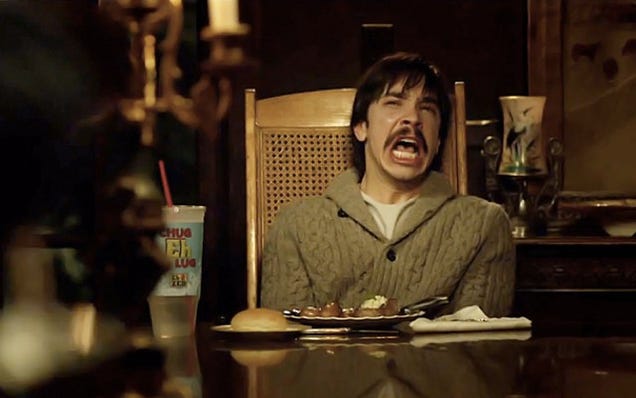
Another seemingly miscast role was Justin Long. There are certain roles where I think Long is a decent comedy actor—he was great in Dodgeball as a geeky teenager, and his similar role in Accepted as a smart-mouthed college kid was enjoyable. Smith has used Long in a cameo role previously in Zack and Miri Make a Porno, portraying a gay porn star, and I found that incredibly funny. A lot of these roles were pretty over the top in the comedy stuff, and comedy is right in his wheelhouse. Tusk, however, represents a role way out in left field. The seriousness of some of the horror scenes don’t fit Long’s acting style at all—as he tries to spin a comedic character, he’s painfully unfunny. For having just met Howe, a mysterious old man who Wallace plans to interview, Wallace speaks with a disgustingly-unamusing candor, almost like Long (or Smith as the writer) was trying too hard to inject some laughs into the mix.

The pendulous way Smith swings from horror back into comedy feels really jarring, and again, it’s hard to tell if he was trying to make a horror film, a comedic romp, or a horror-comedy. Instead of blending the two genres together, we get a comedic sequence followed by a horror scene, then back and forth and back and forth. After one scene that’s actually pretty disturbing where Howe drugs Wallace and experiments on him, the audience is snapped back to Teddy and Ally’s search for Wallace—a search that’s supposed to be hysterical, but ends up being the same trying-too-hard string of jokes. The whole movie hinges on Canada jokes and Canadian stereotypes, and as I watched, I felt secondhand embarrassment for any Canadian viewers. These drawn out sequences absolutely rag on our lovely neighbors to the north, and it was, again, painfully unfunny.

This is, in all honesty, the first Kevin Smith movie that I’m not happy that I watched. There was a laugh or two that I got, but most of the humor in this movie just grated on me and didn’t even make me smile. This movie was based on a “smodcast” from Smith, and a friend of mine said she really enjoyed Tusk since she’d been listening to the movie take shape through these smodcasts. Part of me wonders if it wouldn’t have been better if Tusk had just remained an idea that floated around the smodcast studio and nothing more.


Now that that painful review is over, you may have noticed a small addition to the top-right corner of this blog. I've registered Ticket Stubs and Popcorn Tubs with Bloglovin', which makes it easier for you to follow your favorite blogs and search for new blogs that pique your interests. Give it a shot!

Wednesday, July 22, 2015

Ant-Man: Another Marvel Movie with a Boring Baddie.

Ant-Man

Director: Peyton Reed
Stars: Paul Rudd, Michael Douglas, Corey Stoll, Evangeline Lilly

I’ll throw this out there: I’m a Marvel drone. If it says that Marvel produced the movie, if there’s a cameo from Stan Lee anywhere in the film that makes me laugh, and if there’s an extra scene during the credits, I’m all in. I won’t lie to you, though, my dear reader—I didn’t read the comic books. I never read the comic books. I never had access to them growing up, and it’s only since this latest explosion of superhero movies that Marvel has really piqued my interest. That being said, I felt like 
Ant-Man was a little different than the other Marvel movies. I certainly don’t mean to say that this is an entirely bad addition to Marvel’s ever-expanding cinematic universe—it just felt different.

Ant-Man is a superhero origin story that begins with the release of a prisoner, Scott Lang (Rudd). Lang struggles to find work on the outside, since he's considered a felon—a cat burglar, to be more exact. When the struggle to find a job becomes too much, Lang falls back into old habits and expertly burgles the house of Dr. Hank Pym (Douglas), a scientist who allegedly worked on shrinking technology that reduces the space between atoms. Upon breaking into Pym’s vault, he discovers a red suit, and, being the curious type—fitting for a cat burglar, I suppose—Lang puts on the suit and becomes the Ant-Man. Pym’s former assistant, Darren Cross (Stoll), and Pym’s Daughter, Hope (Lilly), are working on that same shrinking technology, however. Cross develops a suit—named the Yellowjacket—that has the same atom-shrinking abilities, though he sees his weaponized suit as one that will end all wars and make him rich in the process. Lang, Hank, and Hope team up to take down the Yellowjacket to stop the shrinking technology from falling into the hands of the military.

With Ant-Man coming out after the massive release of Avengers: Age of Ultron, it seems like this movie isn’t getting nearly as much hype despite a good amount of advertising. A big part of that is most likely that people like me—people who haven’t read the Marvel comic books—aren’t really sure who Ant-Man is. Iron Man is a huge Marvel character who’s had several movies already, and the same goes for Thor, Hulk, and Captain America. Even before their movies came out, though, I could tell you who each of those characters was, but Ant-Man? I’d never even heard of him before. I think that’s how a solid chunk of movie-goers are going to react to this movie.

Being released after Age of Ultron isn’t going to do Ant-Man any favors, either. With the massive blockbuster success of the second installment of The Avengers, it’s almost like getting sloppy seconds with Ant-Man. Age of Ultron was talked about extensively, and there was a decent-sized advertising campaign, which probably led to its $191 million opening weekend. According to the Internet Movie Database, Ant-Man pulled in just $57 million in its opening weekend. Again, I’m sure there were plenty of avid Marvel fans who have all the comic books lining up at the doors for Ant-Man, but for the average fair-weather Marvel fan like me, I wasn’t really sure what I was getting into.

Like I said when I started, Ant-Man isn’t entirely a bad movie—it’s just different. With Peyton Reed in the director’s seat, I remember a little bit of backlash from the fanbase. Age of Ultron’s director, Joss Whedon, is known for quick-witted dialogue between his characters (just look at his cult television series Firefly) That sharp-tongued humor seems like a good fit for the Marvel cinematic universe if we take anything from the Iron Man movies as well as Guardians of the Galaxy. With Ant-Man, it seems like they were stretching that humor pretty thin. There were funny parts throughout the movie, but none of them seemed as raucously funny as Age of Ultron was. The biggest stretch for humor was the inclusion of Lang’s bumbling crime-buddies who help him set up the heist of Pym’s house. They were a little too slapstick for my taste, and I was a little disappointed that that same level of quick-witted humor wasn’t in this movie. I think the biggest laugh I got was from Stan Lee’s cameo.

My one big complaint was 
Ant-Man’s villain, Darren Cross/Yellowjacket. I get it: 99% of superhero movies dwell on the “good vs. evil” idea, and Ant-Man isn’t an outlier. Yellowjacket is just a foil to Ant-Man in this regard, and neither Yellowjacket nor Cross really get that much character development throughout the whole movie. Hank explains early on that a biological organism must be protected by a special suit when going through the shrinking process, lest the suit’s fuel start fiddling with the chemistry of the organism’s brain. From Cross’s first scene, we already know that he’s the bad guy, since he’s trying to use this astounding technology (A) as a weapon and (B) to make himself stinking rich. I was really miffed as to why the director didn’t flesh out this brain chemistry thing—Hank brings up this idea to Cross just before Cross dons the Yellowjacket outfit, but it seemed too little, too late at that point. Even if there was one quick sequence of Cross using the shrinking technology that tried to show the audience how it altered his mental state, it would have felt less like a loose end while also giving this character more (much needed) depth. I thought Graeme McMillan summed up the issues with Marvel’s villains pretty well in this article.


Will I be rushing out to pick up a copy of Ant-Man when it comes out on blu-ray? Probably not, but it might be nice to have a Marvel movie collection one day. Was it still an enjoyable movie? Sure, if you’re in the mood for a generic villain who you won’t remember once the credits roll.

Now for some house-keeping. I’d like to write here more than I do now, but I don’t have the means to go to the movies on a weekly basis at roughly $15 a pop. Therefore, I’m going to write posts about random movies I find and title it “Movies from Yesteryear.” There are plenty of movies on Netflix and Amazon Prime that I simply haven’t gotten to yet, and when they originally came out in theaters, I thought, “Wow, that’d be cool to write about.” Then they went out of theaters, and I completely forgot about them…until now! Hopefully, by writing about all movies and not just new releases, it’ll give me a little more fodder. Have any other ideas? Let me know!

Tuesday, June 23, 2015

Jurassic World: a Wannabe Horror Flick with a Mediocre Monster

Jurassic World

Director: Colin Trevorrow
Stars: Chris Pratt, Bryce Dallas Howard, Ty Sympkins, Nick Robinson

Like I said in my earlier review of Godzilla (2014), I’m not really one for creature features, but the Jurassic Park franchise will always have a special place in my heart. To get into the spirit of this movie review, I turned on the John Williams station on iHeart Radio.

In Jurassic World, we follow Zach (Robinson) and Gray (Sympkins), brothers who visit the rebuilt, reinvented, and revamped dinosaur theme park. Claire (Howard) oversees the park and all its guests—including her nephews, Zach and Gray—and makes sure the park is financially successful. The park’s success depends on new attractions, and Claire calls on Owen (Pratt) to consult on Jurassic World’s newest member: Indominus Rex, a scarier, cooler dinosaur (kind of).
If you know anything about the older movies in this franchise, you know that Jurassic Park was the brainchild of billionaire John Hammond, and, as we remember, Hammond “spared no expense!” The same is true for this new park—hamster balls that carry guests through the dinosaurs’ pen, trackers embedded in all the dinosaurs to track their movements, and even a genetically-engineered killing machine dinosaur! Oh, wait…probably should have left out that last one.

I love this movie franchise, but at some points in this movie, things got a little ridiculous. I was immediately reminded of a stand-up comedy special from Eddie Izzard who explained Napoleon and Hitler’s plans for invading Russia (viewer discretion advised—language):

"I've got a better idea, got a better idea...OH, it's the same idea, it's the same idea."

After Hammond’s original Jurassic Park was decimated by dinosaurs, one would probably think, “You know, we probably shouldn’t do this again. That was pretty bad.” After the events of both Jurassic Park: The Lost World and Jurassic Park III, wouldn’t somebody have thought, “You know, this was a really stupid idea, what with playing God and all. What a terrible idea.” Now, we seemingly have Hammond’s replacement, Simon Masrani, running the show and providing the funding, and he even says, “The key to a happy life is to accept you are never in control.” Apparently, a happy life would be to accept that you’re never in control—and in doing so, you’d not get eaten by a genetically-engineered killing machine dinosaur.

I must say, however, that the killing machine dinosaur was a bit underwhelming. In Jurassic Park (1993), I remember how terrifying the Tyrannosaurus Rex was, and Indominus Rex didn’t give me that feeling. Steven Spielberg built the suspense surrounding the T-rex using a lot of sounds—I’m sure we all remember the thundering steps in the background as the camera zoomed in on the water rippling in the cup, and who could forget that piercing roar? The Indominus Rex honestly wasn’t all that memorable, and I thought it looked like a Tyrannosaurus Rex with some spines on its back and a longer body. Whereas Jurassic Park’s main monster will forever be burned into my childhood memories, the Indominus Rex of Jurassic World was pretty forgettable.

My partner told me about her viewing experience of Jurassic World, and she noted that the Indominus Rex had some weird special abilities that make it the perfectly-engineered killing machine that “sparing no expense” can buy. I totally agree with her there—the abilities of this baddie dinosaur feel almost tacked on. The geneticist who engineered the Indominus was told to make a “cooler” dinosaur to make Jurassic World a relevant theme park again—guys, you have dinosaurs. (How is this NOT relevant? Jurassic World even featured a dinosaur petting zoo and triceratops rides! Guys, come on!) In any case, these abilities aren’t really explained until later in the movie—the Indominus Rex is a hybrid of multiple animals, and it apparently inherited all of the strengths of those animals, such as camouflaging. The Indominus needed to be overpowered so that it was scary, but because it’s explained so late in film, it’s almost like the writers were saying, “Oh yeah, we forgot to explain why the monster can camouflage…Because we spliced it with a cuttlefish? Yeah, that’s good enough.” Had they explained early on that we spliced this monster together with Animals X, Y, and Z, then discovered that it could do these things, that would have fixed things, I think.

Before the movie had even come out, a buddy asked how I reconciled the Indominus Rex being both female and monstrous, saying that I should watch the Jurassic World trailer and then interpret from that. I can’t formulate an interpretation of a character’s gender when a two-hour movie is boiled down into a two-minute trailer, and at the time, this was the only answer I gave.

Now that I’ve seen the movie, the Indominus Rex had a more masculine construction.. It was a big deal in Jurassic Park that all the dinosaurs were female, because “Life, uh, finds a way”—when humans meddle, problems arise, such as the destruction of the whole theme park. I suppose same theme of gender follows to Jurassic World—the geneticist specifically notes that the Indominus was not bred, but engineered. It seems like this film’s context sets up the idea that genetic engineering and science are masculine activities, and in the real world, that still seems to be the gendered stereotype (though it is just a stereotype). Ergo, the manufacturing of the Indominus Rex in the Jurassic World lab sets the character up as masculine. This masculine construction is pushed further when Hoskins, a corporate big-shot and military visionary (or so he thinks himself) suggests that the Indominus Rex could be used as an asset in warfare: the dinosaur can camouflage itself to hide even from the most advanced detection systems, making it the ultimate stealth operative (except for, you know, being a 50’ long dinosaur). Because the military is so often couched in masculine terms, it seems that the gender construction of the Indominus Rex is masculine.


If we’re talking about Jurassic World with a gendered lens, there’s definitely some sexism going on here, and that’s been a prevailing review of this film. Several people have equated Claire with the archetypical stiff-shirt, career-good-family-bad female character, and as soon as Owen steps on the scene—a man who acts as a “life-force,” Joss Whedon said—then she changes her act and falls into a traditional gender role. As soon as I read some of these reviews, I began nodding, because a lot of if seems pretty spot-on. Claire doesn’t evoke the same level of bad-ass as Dr. Ellie Satler in Jurassic Park, and that’s pretty clear throughout the whole movie. She has a moment or two of breaking traditional gender roles, but that’s about it. I was pretty disappointed in that—going back to my post about Godzilla, I don’t really see much for strong female characters or feminism, for that matter.

It was a good movie—don’t get me wrong. It had action, the pacing was pretty good, and the visuals were spectacular. I also appreciated the subtle and not-so-subtle nods toward Spielberg, such as the younger actors as main characters and the use of shadows throughout the film. Jurassic World got me right in the nostalgia as soon as John Williams’ iconic theme music came on in the theater, but it also showed some invention to the franchise. The movie definitely sets up a sequel, and you’ll definitely find me at the movies when it happens.

Tuesday, June 2, 2015

Mad Max: Fury Road, a High-Octane Feminist Ride

After an absurdly-long hiatus (in which I finished off my master’s degree in English and found a job teaching college English), another post! Seriously, it’s been a year and two days since my last post in this film blog, though I’ve watched numerous films. I even taught a film class this past semester! Thus, it seems apt that I restart this project of mine.

Mad Max: Fury Road
Director: George Miller
Stars: Tom Hardy, Charlize Theron, Nicholas Hoult

What I originally thought was a reboot, Mad Max: Fury Road begins with our hero, Max Rockatansky (Hardy), being taken prisoner. He’s taken in chains to the Citadel, a stronghold that’s built into the side of a group of mesas in the post-apocalyptic world. The Citadel is the property of Immortan Joe, a warlord whose face is always covered by a razor-toothed respirator. In a flurry of action, Max escapes the Citadel with Furiosa (Theron) on the “War Rig”—a souped-up, double-engined semi-truck covered with as many pointy thing as there are hairs in my beard. Max discovers that Furiosa is attempting to smuggle Immortan Joe’s slave-wives—what he calls his “breeders”—away from the Citadel to a safe place called the Green Land. High-octane, stylized violence in a desert wasteland? It’s going to be a bumpy ride. (Don’t forget your seatbelts, kids!)

The first thing I want to address is the film’s focus, which doesn’t necessarily lie with its title character. Rather, the story focuses more so on Furiosa’s quest to get Immortan Joe’s slave-wives to freedom. On a recent forum, I read one person who griped that the movie was called “Mad Max,” not “Mad Max and Furiosa.” Another person complained that the story isn’t even about Max, and that he’s simply thrust into Furiosa’s story. This seems like a misunderstanding of Mad Max’s character, however, since Max is essentially nomadic. If we think back to the original Mad Max: The Road Warrior, Mel Gibson’s character was set up to not belong anywhere. Even the name “the Road Warrior” suggests a level of transitoriness—Max is always on the move, and that can be seen in the opening of Fury Road, as Max stands alone next to his car. That’s basically what his character does—he tags along and helps in other people’s stories, and that kind of character can mean a lot of sequels, since writers can treat the character episodically. As soon as Max finishes helping Furiosa, he can be back on the road and looking for another adventure in which to partake.

The biggest item on the agenda of Fury Road is gender—and it seems like some people are getting hung up on it. Take, for example, this interviewer who asks Tom Hardy if this is supposed to be a “man’s movie”:


On the surface, Fury Road may be just that—a “man’s movie”—but the film implies that this post-apocalyptic wasteland is the result of hypermasculinity. Visually, Immortan Joe is a hypermasculine character: between his hair and his body, he seems far larger than nearly all of his followers, and his muscles are highlighted by his clear, plastic armor plastered with various medals and ribbons from military triumphs. The other two warlords we see in the film are also portrayed as hypermasculine: “the Bullet Farmer” wears a coif made of gun-belts, again bring his military conquests to the forefront; “the People Eater” portrays his hypermasculinity through wealth, as he adorns himself with gold chains and drives a Cadillac-bodied semi-truck. Three of the most socially-powerful characters in the film achieved their position via hypermasculine practices, it seems.

Looking specifically at Immortan Joe, his treatment of those he deems as his inferiors—men, women, and children—shows him as hypermasculine. Joe controls the flow of water throughout the Citadel, and the unwashed masses who live in the dirt below the stronghold are only alive because of his gracious dispensing of the water…by dumping it on them. To Joe, these people are his property, and this is exactly how he treats his wives—especially how he keeps his wives locked up in a vault to use at his disposal. In addition to being locked in vault, their sexuality is also under lock and key, as each of the wives wears a metal chastity belt—a belt with spikes where any mate (besides Joe, of course) would get his member stuck in a very gruesome way. Joe’s feels the need to protect these women, but not because they’re people, no. They’re his property, and Joe’s only reason for keeping them is because they can carry on his perfect, patriarchal, patrilineal family.

There are plenty of strong feminist characters in Fury Road, and that made me really happy. (If you look back at my post about 2014’s Godzilla, it really was a breath of fresh air to have so many strong female characters. Where Immortan Joe see his “breeders” as little more than incubators for his potentially-patrilineal offspring, these women explore a newfound freedom as soon as they’re clear of the Citadel (and as soon as those clunky chastity belts are off). If I understood the movie correctly, it was actually one of the brides who first planned the escape with Furiosa. As the women scream at Joe during one of several visually-stimulating car chase scenes, “We are not property.” I found it interesting that the production team brought on a writer from The Vagina Monologues as a consultant, just to make sure that the female characters were portrayed well; I’ve never heard of another movie doing that, and I thought it was a nice touch. On the topic of strong feminist characters, do I even need to talk about Furiosa, the badass War Rig driver with the mechanical arm?

Overall, this was a hell of a movie. It’s full of action, car chases, and fight scenes, and the pacing of the movie feels good—it doesn’t seem like it drags out or rushes through anything. Visually, this is a stunning movie; I read on IMDb that director George Miller wanted the cinematography to be as colorful as possible to set Fury Road apart from other apocalyptic movies where the colors are all washed out (see The Road, and you’ll understand). The acting is all on-point, and it was engaging all the way through. I would highly recommend this one. Seeing a Valiant Charger mounted on tank treads is all fine and good, but having a movie with this much depth makes for a great experience. 

Friday, May 30, 2014

Godzilla: Monster-bashing good, but lacking great characters

Godzilla
Director: Gareth Edwards
Stars: Aaron Tayler-Johnson, Elizabeth Olsen, Bryan Cranston

I’m not normally one for creature features, and that still holds fairly true after watching this new Godzilla flick. Gareth Edwards’ film follows the story of Ford Brody (Tayler-Johnson), a U.S. Navy soldier and explosive ordnance disposal specialist. As soon as he returns to his family after a tour of duty, he is immediately called to Japan to bail his crackpot nuclear engineer dad (Cranston) out of jail. Once the two are reunited, they search an abandoned nuclear power plant where they uncover a massive operation doing research on something (hint: it’s probably a monster). Here’s the plot twist: it IS a monster, and as soon as that one appears, two more come out of the woodwork. They fly, they swim, they fight. BOOM. Godzilla movie.

The acting in Godzilla is spot on, and the casting is superb. Going into this movie, however, a friend of mine told me to watch out for all the strong female characters in the film. As the credits rolled, I couldn’t find a single strong female character at all—except maybe the one female monster that Godzilla fights. Other than that, the women in this movie appear to be quite useless: Dr. Serizawa (Watanabe) has a female research assistant whose role is absolutely pointless, and she only wanders in his wake to look shocked, apparently. I was really hoping that Ford’s wife, Elle, was going to pick up the slack in this department, but she was incredibly disappointing. Her only purpose throughout the film was to worry and cry about Ford while not doing anything herself. Again, great acting and great casting, but it might have been the fault of the writing on this one.

Speaking of writing flaws, let’s talk about the military’s plan to lure out and kill the monsters. It’s almost halfway through the movie when we discover that Godzilla and his two monstrous adversaries feed off of radiation, whether it comes from sapping energy from a nuclear power plant or from guzzling barrels of radioactive waste. The baddie-monsters are on top of any nuclear power source like flies on a gut wagon, so what’s the military’s response? “Well, we’ve got all these nukes just sitting around…” One guy exclaimed that the nuclear bombs dropped on Japan near the end of WWII were “just firecrackers” compared to the nukes we have now, explicitly noting that nuclear weapons today aren’t measured in kilotons anymore, but megatons. So…let me get this straight. The monsters nom-nom on radiation, such as, oh, I don’t know, a bunch of nuclear weapons…and you want to use nuclear weapons against them. Why not just put the world’s nuclear arsenal out on a table with some twenty foot tall candles and let the baddies have a nice romantic dinner with a main course of radiation? This seems like a major plot hole.

The real solution to this mess was suggested by Dr. Serizawa early on: humans, just sit down, shut up, and let the grown-ups handle this (and by grown-ups, I mean the 100’ tall radiation monsters). Serizawa says that we should just let Godzilla take care of the other monsters and get the hell out of the way, which is basically what works. As Godzilla goes on the hunt to restore balance to the world by killing the other monsters, the Navy follows Godzilla as he swims the breadth of the Pacific Ocean—watching all those battleships and destroyers form up on the massive radiation-fueled reptile gave me flashbacks to the old Weekly World News tabloids where Bat-Boy joined the war on terror. Where the old Godzilla movies used the beast as a warning against the destructive power of nuclear energy and nuclear armament, this new Godzilla flick promotes the idea of human hubris: throughout the movie, humans are scurrying around making plans (and spectacularly failing at those plans) when the only thing that can stop a monster is another monster.

Thinking of the structure of the movie, the first two-thirds of the movie were rather dull, and the plot only picked up when the monsters started going at each other in the last chunk of the film. Again, the lack of strong female characters was incredibly disappointing, especially because the beginning two-thirds of the movie were all character-driven with human characters. By having a few more interesting characters, it could have been a much better movie. Another review I glanced at said that there wasn’t much action in this movie for being labeled as an action movie, and I wholeheartedly agree.


If a Godzilla II were to come out, would I go see it? Maybe, maybe not. Godzilla wasn’t a bad movie, by any stretch of the imagination, and the special effects alone were worth paying for the ticket. I even watched this movie in 3D, and that’s something I rarely do, since most 3D movies throw things at the audience, and that seems rather gimmicky to me. In the case of Godzilla, however, the 3D felt very natural—it never once pulled my attention away from the story with a stupid shot of something flying at my face. Overall, Godzilla was okay, but I don’t think I’ll be rushing to buy a copy of it later down the road. 

Thursday, May 29, 2014

Introduction, and the Amazing Spiderman 2 Review

Welcome to my new blog! Here, you’ll find movie reviews for newer movies from various genres (along with a healthy dose of sarcasm—no, really, a lot of sarcasm).

For the longest time, I’ve wanted to write a blog like this, but I never had the time or the ambition to do it. I took several television and film classes in college which sparked my love for film; it was never just about watching movies, though, but rather writing, filming, and acting in movies. More than anything, I just like to have fun with movies, whether it’s watching them or making them, and this is the primary focus of this blog.

The movies I like watching are normally action-based, although I like to watch a broad smattering of things. When I say action-based movies, sometimes I truly mean dyed-in-the-wool actions flicks with Arnold Schwarzenegger lumbering around and not looking at the explosions he’s caused (you know, like action heroes do). Other times, action-based movies fall more into the sci-fi or fantasy realm, but a big portion of those action-based movies I like are superhero movies.

Now that I’ve set up the perfect segue into this first post, here’s my latest viewing!

The Amazing Spiderman 2
Director: Marc Webb (oh, the puns!)
Stars: Andrew Garfield, Emma Stone, Jamie Foxx, Paul Giamatti

The Amazing Spiderman 2 follows the story of Peter Parker, a teenage boy who was bitten by a genetically-modified spider, thus giving him arachnid-like superpowers. “Spiderman” is an apt description of a superhero with arachnid-like powers. In this sequel to The Amazing Spiderman, our friendly neighborhood webslinger faces off against baddies such as Electro and the Green Goblin, both products of the evil Oscorp company.

A more apt title might have been “Spider-boy,” since the story of The Amazing Spiderman 2 devolves into a structuralist superhero plot full of teenage angst—even among those characters who aren’t even teenagers. Peter and Gwen Stacey continue their romantic fling from the first movie, though Peter is now plagued by images of Gwen’s father, killed off by the Lizard in the climactic final battle. Peter has to make the cliché decision that Tobey Maguire faced in 2004’s Spiderman 2: do I live a normal life with normal relationships, or do I accept my responsibilities as the guy who was accidentally bitten by a super-spider? We see the same double-identity crisis in almost all superhero movie sequels, such as Batman wanting to hang up his cowl and be with Rachel Dawes in The Dark Knight, so I found the structural plot of The Amazing Spiderman 2 to be a bit played out.

Another played-out theme in The Amazing Spiderman 2 was the real-world grittiness that Webb was trying to spin. (Get it? Webb? Spin? I’ll show myself out later.) Webb seems to be emulating Christopher Nolan here by trying to bring that same Batman grittiness to the Spiderman universe, like how the Rhino looks like an Ironman suit (you know, shaped like a rhino). The character Spiderman seems to be geared more so toward younger audience, which seems fitting, since Peter Parker graduates from high school in the first few minutes of the film, and that Batman-esque grit doesn’t seem to fit the light-hearted, quick-witted feel of Garfield’s Peter Parker.

By trying to establish that real-world grit like Nolan, the Electro character in The Amazing Spiderman 2 annoyed me—a lot. Max Dillon, played by Jamie Foxx in the film, starts out as your run-of-the-mill electrical engineer for Oscorp, and he is saved from death one day by Spiderman. Spiderman tells Dillon something to the effect of “I need you, buddy,” and Dillon becomes obsessed with Spiderman like a teenage girl with Bieber-fever. The film attempts to set up Dillon as mentally unstable, as he plays out violent scenarios in his head and apparently hears voices (which are portrayed during the soundtrack in a corny dubstep rap). The mental instability of Electro is pushed a little too far, though, because he seems more like an unruly teenager lighting fires (or electrocuting things) for attention from Spiderman. Where Nolan’s villains like the Joker or Bane actually made me uneasy because of their lack of humanity, Electro never seemed like that much of a threat in this movie because he didn’t want to hurt anyone—he just wanted to be noticed, like an emo kid that just needed a hug.

In all honesty, I really prefer Garfield’s portrayal of Spiderman as a sharp-tongued kid when compared to Maguire’s straight-laced, one-liner superhero. With Garfield’s excellent and fun portrayal of Spiderman, along with the awesome on-screen chemistry he has with Emma Stone, the protagonist side of The Amazing Spiderman 2 was right up my alley. That being said, the antagonists of the film—the attention-seeking Electro, the daddy-issues Green Goblin, and the tacked-on Rhino—didn’t hold up their end of the movie.


Thanks for reading!